
Glazed earthenware plate with calligraphic inscription, Φ29.2 x 5.5 cm
When Tokyo gallerist Takayuki Ishii visited the family of Ikebana master and sculptor Sofu Teshigahara (1900–1979) (to whom he has already dedicated several exhibitions, including one in 2024: https://www.takaishiigallery.com/en/archives/37253/), he stumbled upon a box filled with ceramic dishes inscribed with the master’s calligraphy. Never or rarely exhibited, these pieces, unveiled at the Taka Isshii Gallery in Roppongi (Tokyo), are displayed on a long table covered with a white tablecloth. Visitors are invited to a banquet hosted by an ‘monstre d’art’ who was at once a master of Ikebana, sculptor, calligrapher, painter and collage artist – an artist of many talents.
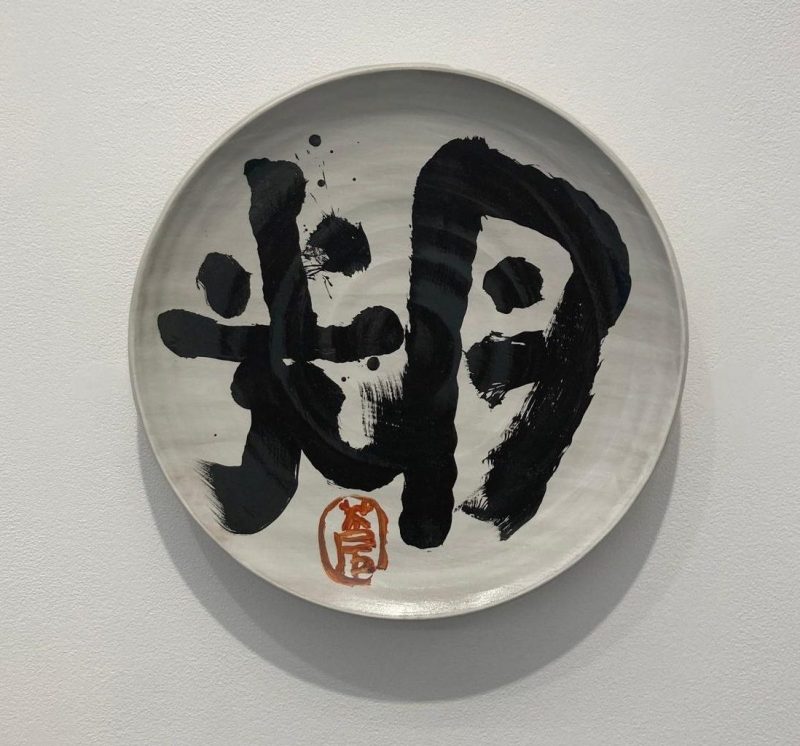
“Gekko”(Moonlight), n.d.
Glazed earthenware plate with calligraphic inscription Φ40.8 x 5 cm
To me, these exhibits are so-called unidentified art objects. How should they be classified? As ceramics? Not really. As calligraphy? Although the kanji (Chinese characters) are sometimes easily identifiable, they are often distorted, swept away by the expressionist fever of Teshigahara’s brush, and are difficult to read. As painting? There are signatures but no dates, only a few clues that they were probably created in the 1960s and 1970s, when Teshigahara was already an established artist in Japan and internationally. In 1927, Sofu founded the Sogetsu School of Ikebana: Born in a family of Japanese floral art masters, he broke with the rigidity of the conventions of this practice and became the leader of the avant-garde Ikebana movement that emerged after the Second World War, alongside Houun Ohara and Yukio Nakagawa. He also frequented the Japanese artistic avant-garde of the 1960s and 1970s—the Gutai group, Jikken Kobo, Art Informel—and opened his Sogetsu Art Centre (which ceased operations in 1971) in Tokyo to John Cage and choreographer Merce Cunningham. In 1978, a year before his death, he collaborated with Japanese-American designer Isamu Noguchi, who created a large-scale installation, Heaven, for the Sogetsu school headquarters in Tokyo.
These pieces acquire a value that goes beyond the simple fact of having been created by Sofu Teshigahara. This value lies in a gesture that, at first glance, seems somewhat rebellious, but which proves poetic in its choice of words. It is as much an affirmation of self as it is a tribute to tradition, which dictates that Japanese master potters offer their apprentices a piece calligraphed or painted by their own hand.
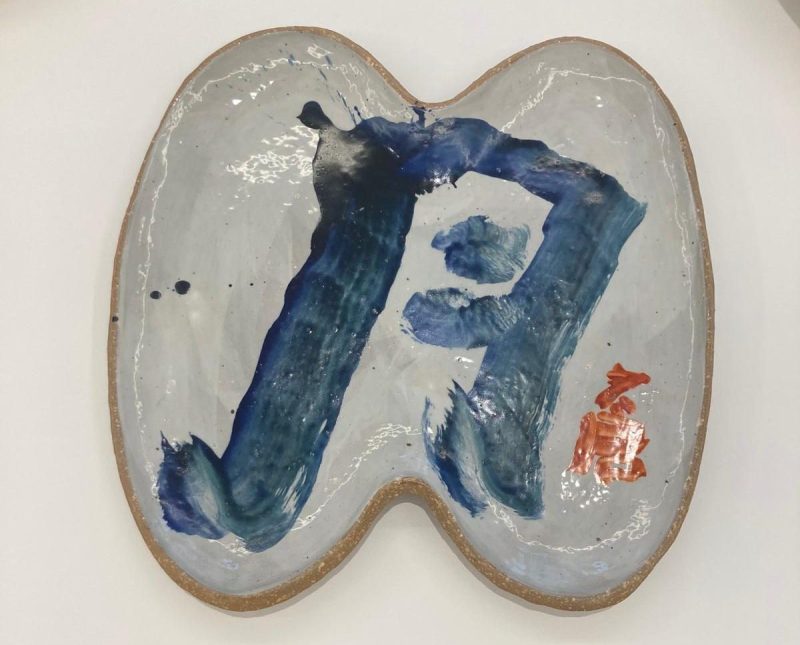
“Tsuki”(Moon), n.d.
Glazed earthenware plate with calligraphic inscription, 36.8 x 36.5 x 4.2 cm
Visit the exhibition at the Taka Isshi Gallery until September 27th
 idl art consulting
Laisser un commentaire